
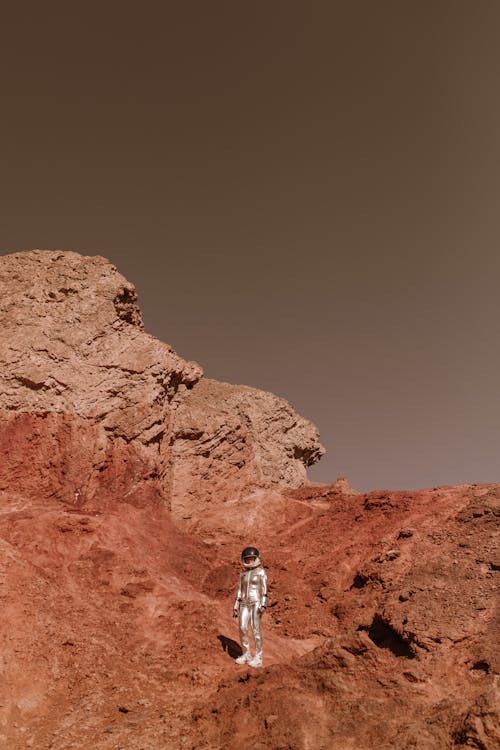
In a historic revelation that could reshape our understanding of the universe, the Mars Rover, diligently exploring the Martian surface, has provided compelling evidence suggesting the existence of ancient microbial life on the Red Planet. The groundbreaking findings come after years of meticulous analysis and exploration by the robotic rover, Curiosity.
NASA's Curiosity Rover, which touched down on the Martian surface in August 2012, has been on a quest to unravel the mysteries of Mars and assess its potential habitability. Equipped with advanced scientific instruments, the rover has been collecting data on soil composition, atmospheric conditions, and geological features to provide insights into the planet's past.
The recent discovery centers around sedimentary rocks in the Gale Crater, where the rover has been conducting extensive research. Dr. Emily Parker, lead astrobiologist on the Curiosity mission, presented the findings at a press conference held at NASA's Jet Propulsion Laboratory.
"We have uncovered compelling evidence of what appears to be ancient microbial life on Mars. The sedimentary rocks in Gale Crater contain distinct organic molecules and patterns that strongly resemble microbial structures found on Earth," Dr. Parker announced, her voice brimming with excitement.
The discovery hinges on the identification of organic molecules, the building blocks of life as we know it, within the Martian rocks. The rover's Sample Analysis at Mars (SAM) instrument, designed to analyze the chemical and isotopic composition of samples, played a crucial role in this revelation. The instrument detected complex organic molecules that are indicative of past life processes.
Dr. Parker explained, "These organic molecules are the fingerprints of potential microbial life. While we cannot directly confirm the existence of ancient Martian microbes, the evidence strongly suggests that conditions may have been conducive to life in Mars' distant past."
The Gale Crater, chosen as the rover's landing site for its geological diversity, has been a treasure trove of information. Its layered rock formations provided a chronological record of Mars' history, akin to the way tree rings reveal the age of a tree. Scientists have been able to trace the evolution of the Martian environment, indicating a time when the planet may have harbored liquid water—a key ingredient for the emergence of life.
In addition to the organic molecules, Curiosity's high-resolution cameras captured images of structures resembling fossilized microbial mats. These layered structures, reminiscent of stromatolites found on Earth, suggest the presence of microbial life in Mars' ancient past.
The revelation has ignited a wave of excitement and anticipation in the scientific community and beyond. Dr. Jonathan Ramirez, a renowned astrobiologist not affiliated with the mission, commented, "This discovery is a game-changer. It opens up the possibility that life, even in its simplest forms, may be more widespread in the universe than we previously thought. Mars, once considered a barren and inhospitable planet, is now a potential archaeological site for extraterrestrial life."
The implications of this discovery extend beyond the realm of astrobiology. It poses profound questions about the origins of life in the universe and the potential for life beyond Earth. Dr. Parker emphasized the need for further exploration and the importance of upcoming missions, including the Mars Sample Return mission, which aims to collect and return samples from the Martian surface to Earth for more detailed analysis.
"As exciting as this discovery is, there is much more to learn. The Mars Sample Return mission will allow us to examine Martian samples in laboratories on Earth, providing a level of scrutiny and analysis that is currently beyond the capabilities of our rover on Mars," Dr. Parker explained.
While the news has captured the imagination of scientists and space enthusiasts alike, it has also sparked discussions about the ethical considerations surrounding potential contamination. The idea that microbial life may have existed on Mars raises questions about the responsibility of future missions to avoid introducing Earth microorganisms that could compromise the integrity of any Martian biosignatures.
The discovery on Mars comes at a time when the scientific community is increasingly focused on the search for extraterrestrial life. Advances in telescope technology have allowed astronomers to identify potentially habitable exoplanets in distant star systems, while missions to icy moons like Europa and Enceladus have raised the possibility of subsurface oceans that could harbor life.
The Mars Rover's findings will undoubtedly shape the direction of future exploration missions, with scientists eager to explore areas of Mars that may have once hosted liquid water. The tantalizing prospect of finding direct evidence of past or even present life on Mars has reinvigorated interest in the red planet and increased public support for space exploration initiatives.
As humanity contemplates the implications of the Mars Rover's discovery, the quest for understanding our place in the cosmos takes a giant leap forward. The ancient microbial life hinted at in the Martian rocks opens a new chapter in the ongoing search for life beyond Earth, pushing the boundaries of human knowledge and inspiring the next generation of explorers to reach for the stars.
إرسال تعليق